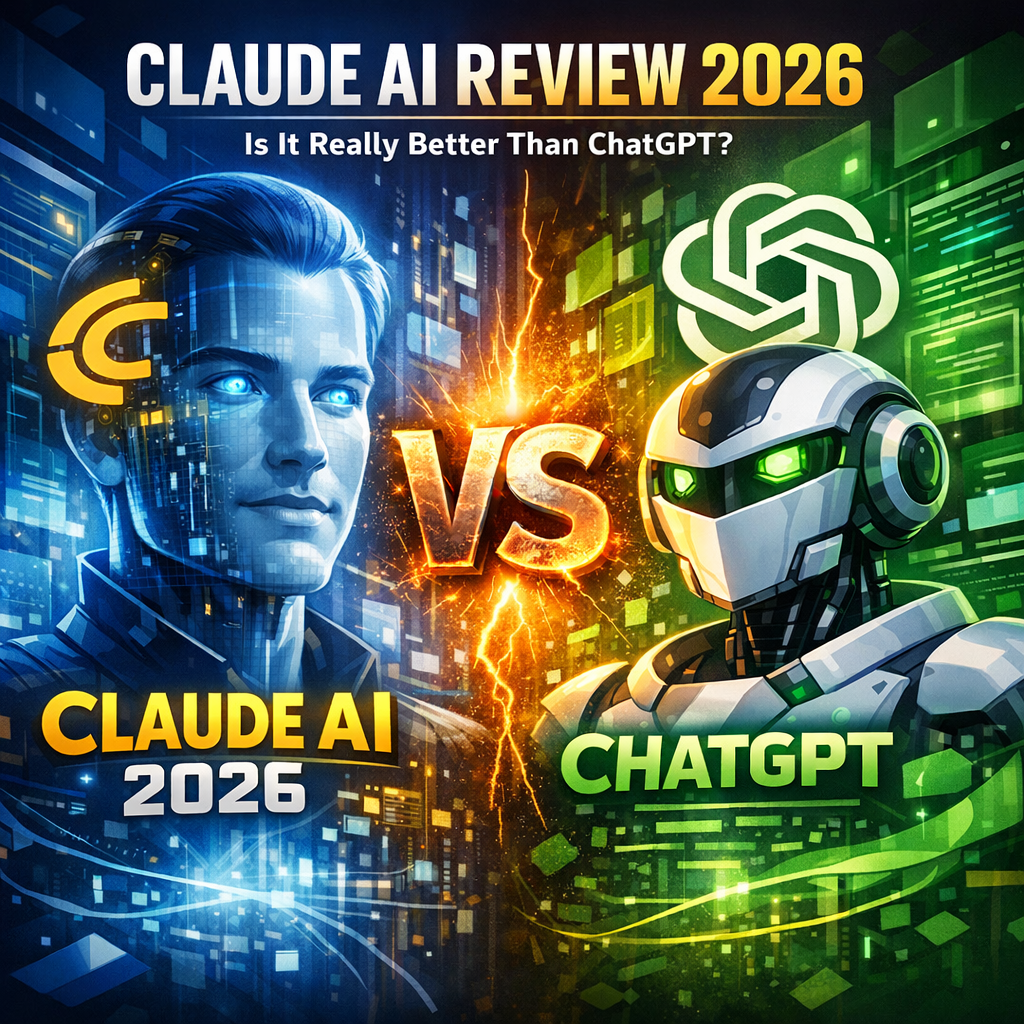
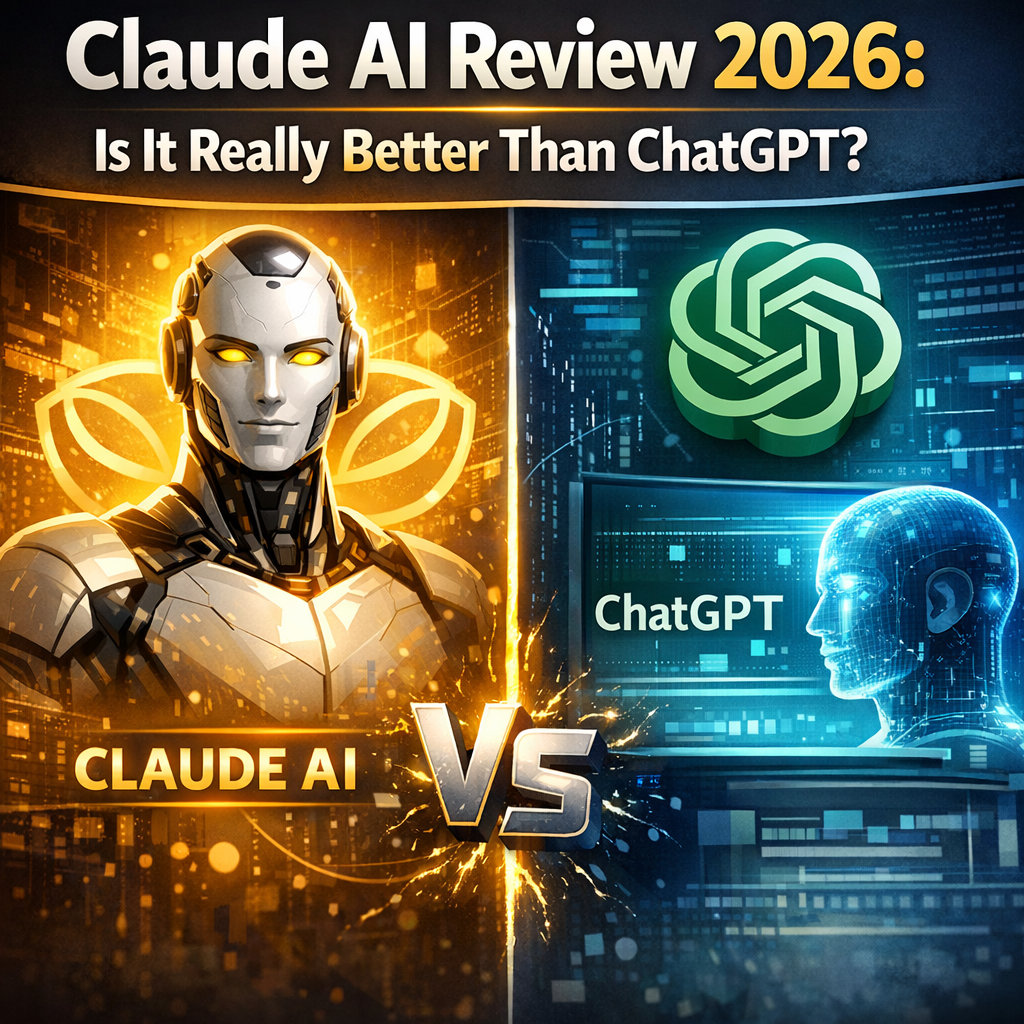
Claude AI Review 2026: Is It Really Better Than ChatGPT?
- What Is Claude AI?
- Claude AI in 2026: Key Features
- 1. Extended Context Window
- 2. Reasoning and Analysis
- 3. Writing Quality and Tone
- 4. Coding Capabilities
- 5. Safety and Honesty
- Claude vs. ChatGPT: The Head-to-Head Comparison
- Context Window
- Writing Quality
- Coding
- Speed and Availability
- Safety and Reliability
- Pricing
- Who Should Use Claude AI?
- Writers and Content Creators
- Legal, Medical, and Research Professionals
- Software Developers
- Educators and Students
- Businesses and Enterprises
- Where Claude Still Falls Short
- Ecosystem and Integrations
- Image Generation
- Real-Time Web Access
- Memory and Personalization
- The Bigger Question: Safety vs. Speed
- Final Verdict
- Conclusion
Claude AI Review 2026: Is It Better Than ChatGPT?
Artificial intelligence has moved faster in the past two years than most experts predicted. What felt like a distant future — AI that reasons, codes, writes, and converses like a knowledgeable colleague — is now sitting in your browser tab. At the center of that conversation are two names: Claude and ChatGPT.
If you’ve been searching for a thorough claude ai review or a claude review 2026, you’ve landed in the right place. This post digs deep into what Claude offers today, how it stacks up against OpenAI’s ChatGPT, and whether it deserves a spot in your daily workflow.
What Is Claude AI?
Claude is a family of large language models developed by Anthropic, an AI safety company founded in 2021 by former OpenAI researchers, including Dario Amodei and Daniela Amodei. The name “Claude” comes from Claude Shannon, the father of information theory — a fitting tribute for a model built around careful, structured communication.
Anthropic’s core philosophy sets it apart from the beginning. Rather than racing purely for capability, the company has invested heavily in Constitutional AI (CAI), a training methodology designed to make models more honest, harmless, and helpful. The idea is to give the AI a set of principles — a “constitution” — and have the model critique and revise its own outputs according to those principles during training.
By 2026, Claude has gone through several major iterations:
- Claude 1 — The proof of concept that showed Anthropic could train a competitive model
- Claude 2 — Introduced a massive 100K token context window, a feature that shocked the industry
- Claude 3 (Haiku, Sonnet, Opus) — A tiered model family matching different needs and budgets
- Claude 3.5 Sonnet and Opus — Significant leaps in reasoning, coding, and multimodal understanding
- Claude 4 (2025-2026) — The current flagship, pushing the frontier on extended reasoning, tool use, and agentic workflows
Today’s Claude is no longer just a chatbot. It’s a capable reasoning engine, a coding partner, a document analyst, and increasingly, an autonomous agent.
Claude AI in 2026: Key Features
1. Extended Context Window
One of Claude’s most celebrated technical differentiators has always been its large context window. While ChatGPT made headlines with GPT-4’s 128K context window, Claude has historically matched or exceeded this, and by 2026, the Claude 4 models support context windows large enough to process entire codebases, lengthy legal documents, or a full novel in a single session.
Why does this matter in practice?
Imagine you’re a lawyer who needs to analyze a 300-page contract. With a smaller context window, the AI needs to “forget” earlier sections as it processes later ones. With Claude’s extended context, the model can hold the entire document in memory, cross-reference clauses, and answer nuanced questions about the full text without losing track.
For developers, this means dropping an entire repository into Claude and asking, “Where is the authentication logic, and is there a security vulnerability in how JWT tokens are handled?” — and getting a coherent, well-reasoned answer.
2. Reasoning and Analysis
Claude has consistently been praised for the quality of its reasoning. In the 2026 landscape, Claude 4 Opus performs exceptionally well on:
- Complex multi-step math problems
- Scientific reasoning and hypothesis analysis
- Ethical dilemmas (where it tends to provide structured, nuanced responses)
- Logical deduction and inference tasks
The model doesn’t just arrive at answers — it tends to show its work in a transparent way that makes it easier to verify, correct, or build upon.
3. Writing Quality and Tone
Ask most professional writers which AI produces more natural, less robotic prose, and a significant percentage will tell you: Claude.
Claude’s outputs tend to read with better sentence variety, a more controlled tone, and less of the telltale “As an AI language model…” hedging that used to plague early ChatGPT responses. For content creators, marketers, and journalists, this matters enormously.
Whether you’re drafting a blog post, writing a product description, crafting a cold email, or polishing a research paper, Claude’s writing feels more intentional and nuanced.
4. Coding Capabilities
Claude has become a serious competitor in the coding assistant space. In internal benchmarks and community testing throughout 2025 and 2026:
- Claude 4 Sonnet competes directly with GPT-4o on HumanEval and similar benchmarks
- It handles multi-file refactoring tasks particularly well due to its large context window
- It explains code clearly, making it an excellent teaching tool for developers learning new frameworks
- Integration with tools like Cursor, VS Code, and GitHub Copilot alternatives has made Claude part of many developers’ daily stack
One area where Claude particularly shines is in debugging complex systems. Rather than just identifying a bug, it often traces the issue through multiple files or functions and explains the root cause before suggesting a fix.
5. Safety and Honesty
This is where Anthropic’s philosophy shows up in daily use. Claude is designed to:
- Acknowledge uncertainty rather than confabulate confident-sounding wrong answers
- Decline harmful requests while explaining why, rather than silently refusing or complying
- Push back on premises it finds factually incorrect, even if the user is insistent
For business users who depend on accurate information, this behavioral characteristic is genuinely valuable. A model that confidently makes up statistics is a liability. A model that says, “I’m not certain about this figure — you should verify it with a primary source,” is a partner.
Claude vs. ChatGPT: The Head-to-Head Comparison
Let’s get to the comparison you came here for.
Context Window
| Feature | Claude 4 Opus | GPT-4o |
|---|---|---|
| Context Window | 200K+ tokens | 128K tokens |
| Long Document Analysis | Excellent | Good |
| Code Repository Analysis | Excellent | Good |
Winner: Claude — for long-document and large-codebase tasks, Claude holds an advantage.
Writing Quality
Both models produce excellent writing. However, user surveys and professional feedback consistently note that Claude’s prose reads as more natural and less formulaic. ChatGPT has improved significantly with GPT-4o and its successors, but Claude still tends to edge it out in nuanced, long-form writing tasks.
Winner: Claude (slightly) for long-form and nuanced writing; roughly tied for short-form marketing copy.
Coding
This is a genuine toss-up that depends on your specific use case:
- ChatGPT (with Code Interpreter/Advanced Data Analysis) remains excellent for data science, Python scripting, and visualization tasks
- Claude tends to perform better on large-scale refactoring, multi-file tasks, and explaining complex systems
Winner: Tie, with slight edges in different niches.
Speed and Availability
OpenAI has a more mature infrastructure and a broader API ecosystem. ChatGPT’s integration with Microsoft products, the breadth of third-party plugins, and the established developer community give it an edge in ecosystem maturity.
Claude, while available via API and through Claude.ai, has fewer native integrations — though this gap is closing in 2026 with Anthropic’s expanding partnership network.
Winner: ChatGPT for ecosystem breadth and speed of response at scale.
Safety and Reliability
For enterprise and regulated industries, Claude’s safety-first approach provides measurable benefits:
- Fewer hallucinated citations
- More consistent refusal of genuinely harmful content
- Better calibration of confidence in responses
Winner: Claude for reliability in high-stakes or regulated environments.
Pricing
Both platforms offer free tiers with limitations, and paid plans at roughly comparable price points. As of 2026:
- Claude.ai Pro offers access to Claude 4 Sonnet and Opus at competitive rates
- ChatGPT Plus gives access to GPT-4o and newer models
- For API usage, pricing varies by token count and model tier
Neither is dramatically cheaper than the other at the individual level. Enterprise pricing differs by contract.
Winner: Roughly equal, depending on use case and volume.
Who Should Use Claude AI?
Writers and Content Creators
If your livelihood depends on the quality of your prose, Claude is worth prioritizing. The writing it produces requires less editing, maintains tone better over long-form content, and handles nuanced instructions with precision.
A content agency using Claude for first-draft generation will spend less time rewriting generic-sounding paragraphs and more time adding their unique voice on top of a solid foundation.
Legal, Medical, and Research Professionals
Claude’s large context window and commitment to acknowledging uncertainty make it better suited for document-heavy, accuracy-critical workflows. Whether you’re analyzing case law, reviewing clinical trial summaries, or synthesizing academic literature, Claude handles volume and nuance well.
Software Developers
For developers working on large codebases, Claude’s context capabilities are genuinely transformative. Pair it with a tool like Cursor or use it directly through the API to build AI-assisted code review pipelines, and you have something genuinely powerful.
That said, if your work skews heavily toward data analysis, Python notebooks, or visual output, ChatGPT’s Code Interpreter and broader tool integrations may still serve you better.
Educators and Students
Claude’s patient, structured explanations make it an excellent educational tool. Ask it to explain quantum entanglement at three different levels of complexity, and it delivers three genuinely distinct explanations rather than rephrasing the same paragraph. For students learning complex subjects, this scaffolded explanation style is exceptional.
Businesses and Enterprises
Organizations in finance, healthcare, legal, and compliance-heavy industries will find Claude’s reliability and safety characteristics compelling. Anthropic has also invested heavily in its enterprise API offering, with better data handling commitments and compliance documentation than some competitors.
Where Claude Still Falls Short
No claude ai review would be complete without honest limitations.
Ecosystem and Integrations
ChatGPT benefits from years of ecosystem development. GPT integrations are baked into Microsoft Office, countless SaaS products, and thousands of custom GPT tools. Claude is catching up, but for users who live inside complex software stacks, ChatGPT’s integrations remain a practical advantage.
Image Generation
Claude does not generate images. ChatGPT, connected to DALL-E 3 and increasingly to third-party image models, can produce visual content within the same conversation. For creative professionals who need both text and image capabilities in one tool, this is a real limitation.
Real-Time Web Access
Claude’s web browsing capabilities, while improved, have historically lagged behind ChatGPT’s Bing-integrated search features. For tasks that require up-to-the-minute information — breaking news, live pricing, current events — this gap matters.
Memory and Personalization
OpenAI has invested in long-term memory features that allow ChatGPT to remember details about you across conversations. Claude’s memory capabilities, while improving, are still more limited in the default experience. For users who want the AI to feel like it “knows” them over time, ChatGPT currently offers more here.
The Bigger Question: Safety vs. Speed
Beyond the feature checklist, choosing between Claude and ChatGPT involves a philosophical question about what you want from an AI.
OpenAI has moved fast, shipped aggressively, and built an enormous ecosystem. The result is a powerful, deeply integrated tool that sometimes prioritizes capability over caution.
Anthropic has moved deliberately, kept safety at the center, and built a model that tends to be more honest about what it doesn’t know. The result is a slightly slower-moving product that many users trust more for critical work.
Neither approach is wrong. But if you’re building an internal tool at a hospital, a legal research assistant, or an educational platform for teenagers, you might care deeply about which philosophy is behind the model you’re using.
Final Verdict
So, is Claude better than ChatGPT in 2026?
For many professional use cases: yes. Claude’s writing quality, long-context reasoning, safety characteristics, and ability to handle large documents make it the better tool for knowledge workers, researchers, developers working on complex systems, and regulated industries.
For general consumer use and integrated workflows: it’s close, but ChatGPT’s ecosystem advantages, image generation capabilities, and memory features keep it relevant and often preferred.
The honest answer is that both tools have earned their place in the modern AI toolkit. Smart professionals are increasingly using both — leveraging Claude for deep document analysis, long-form writing, and nuanced reasoning, while using ChatGPT for quick queries, visual tasks, and workflows tied to Microsoft or other integrated platforms.
What’s clear is that Anthropic’s bet on safety and quality has paid off. Claude is no longer the thoughtful but slower alternative to ChatGPT — it’s a genuine competitor that outperforms in meaningful categories.
Conclusion
This claude review 2026 comes to a clear conclusion: Claude AI has matured into one of the most capable and trustworthy AI assistants available today. Its strengths in long-context reasoning, writing quality, coding support for large projects, and safety-first behavior make it an excellent choice — and in several key areas, the best choice.
If you haven’t used Claude seriously in the past year, it’s time to revisit. The gap between it and ChatGPT has closed considerably in Claude’s favor on the dimensions that matter most for professional use.
The best AI tool isn’t always the most famous one. In 2026, Claude makes a compelling case for why safety and quality don’t have to come at the cost of performance.