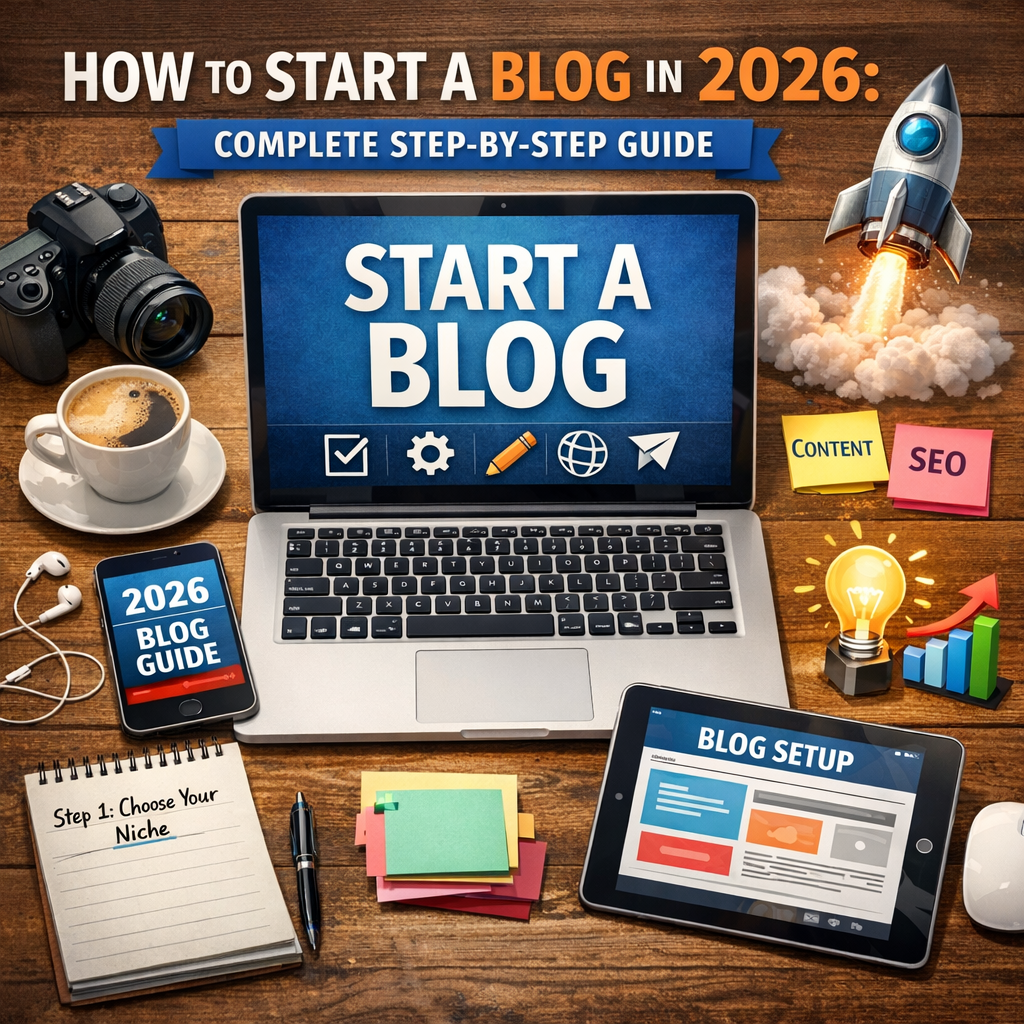
How to Start a Blog in 2026: Complete Step-by-Step Guide
- Why Start a Blog in 2026?
- Step 1: Choose Your Blog Niche
- How to Find Your Niche
- Niche Examples That Work in 2026
- Validate Your Niche
- Step 2: Pick a Blogging Platform
- WordPress.org — Still the Gold Standard
- Other Platforms Worth Considering
- Step 3: Get Hosting and Register a Domain Name
- Choosing a Domain Name
- Choosing a Web Host
- Installing WordPress
- Step 4: Design Your Blog
- Choose a Theme
- Essential Design Principles
- Must-Have Pages to Create
- Step 5: Set Up Essential Plugins and Tools
- Essential Plugins for 2026
- Set Up Google Analytics and Google Search Console
- Step 6: Create Your Content Strategy
- Keyword Research for Bloggers
- Types of Blog Posts That Perform in 2026
- Build a Content Calendar
- Step 7: Write and Publish Your First Blog Posts
- Anatomy of a High-Performing Blog Post
- Post Length in 2026
- Using AI Tools Responsibly
- Step 8: Promote Your Blog
- SEO (Search Engine Optimization)
- Social Media Promotion
- Build an Email List from Day One
- Step 9: Monetize Your Blog
- Top Blog Monetization Methods
- Step 10: Track, Analyze, and Improve
- Common Mistakes to Avoid When Starting a Blog
- Conclusion
How to Start a Blog in 2026: Complete Step-by-Step Guide
Starting a blog in 2026 is one of the smartest decisions you can make — whether you want to build a personal brand, generate passive income, share your expertise, or simply document your journey. But the blogging landscape has shifted significantly. AI tools are everywhere, competition is fierce, and readers expect more value than ever before.
The good news? The fundamentals of building a successful blog haven’t disappeared. They’ve just evolved. This complete step-by-step guide will walk you through everything you need to know about how to start a blog in 2026 — from picking your niche to publishing your first post and beyond.
Why Start a Blog in 2026?
Before diving into the how-to, let’s address the elephant in the room: Is blogging still worth it in 2026?
The answer is a resounding yes — but with important caveats.
While AI-generated content floods the internet, human-centered, experience-driven blogs are actually more valuable than ever. Google’s E-E-A-T framework (Experience, Expertise, Authoritativeness, and Trustworthiness) rewards content written by real people with real knowledge. Readers are craving authenticity in a sea of robotic, generic articles.
Here’s what blogging can do for you in 2026:
- Generate passive income through ads, affiliate marketing, and digital products
- Build your personal brand and establish yourself as an authority
- Drive traffic to your business or freelance services
- Create a creative outlet for your thoughts and expertise
- Build a community of like-minded readers
Now, let’s get into the step-by-step process.
Step 1: Choose Your Blog Niche
Your niche is the foundation of everything. A blog that tries to cover every topic ends up connecting with no one. A focused blog attracts a loyal, engaged audience that keeps coming back.
How to Find Your Niche
Ask yourself three questions:
- What am I passionate about? You’ll be writing consistently for months or years. Passion keeps you going when motivation dips.
- What do I know a lot about? Your experience and expertise are your biggest differentiators from AI-generated content.
- Is there an audience for it? Passion meets profitability when people are actively searching for what you know.
Niche Examples That Work in 2026
- Personal finance for freelancers
- Sustainable living on a budget
- Remote work productivity tips
- Mental health for entrepreneurs
- Parenting teenagers in the digital age
- Budget travel in Southeast Asia
The sweet spot is a niche that’s specific enough to stand out but broad enough to have plenty of content ideas. “Personal finance” is too broad. “Personal finance for first-generation college graduates” is perfectly specific.
Validate Your Niche
Before committing, validate your niche by:
- Searching your topic on Google and checking the volume of results
- Using free tools like Google Trends or Ubersuggest to assess search interest
- Browsing Reddit, Quora, or Facebook Groups to see if people are actively asking questions about your topic
- Checking if other blogs in the space are monetizing successfully (a sign the audience spends money)
Step 2: Pick a Blogging Platform
In 2026, you have more blogging platform options than ever. But not all platforms are created equal, especially if you want to monetize and fully own your content.
WordPress.org — Still the Gold Standard
WordPress.org (self-hosted) remains the top choice for serious bloggers. It powers over 40% of all websites on the internet for good reason:
- Complete ownership and control over your content
- Thousands of free and premium themes
- Thousands of plugins for SEO, speed, and functionality
- Full monetization freedom
The slight downside? You need to pay for hosting and manage some basic technical setup — but it’s easier than ever in 2026.
Other Platforms Worth Considering
| Platform | Best For | Monetization |
|---|---|---|
| WordPress.org | Serious bloggers | Full freedom |
| Ghost | Writers and newsletter bloggers | Subscriptions |
| Squarespace | Visual/portfolio blogs | Limited |
| Medium | Exposure and partner program | Limited |
| Substack | Newsletter-first content | Subscriptions |
Recommendation for 2026: If your goal is long-term growth and income, go with WordPress.org. If you’re primarily building a newsletter audience, Ghost or Substack are excellent alternatives.
Step 3: Get Hosting and Register a Domain Name
If you go with WordPress.org (which we recommend), you’ll need two things: a domain name and web hosting.
Choosing a Domain Name
Your domain name is your blog’s address on the internet. Here are best practices for choosing one:
- Keep it short and memorable — aim for fewer than 15 characters
- Make it easy to spell and pronounce
- Use .com whenever possible — it’s still the most trusted extension
- Avoid numbers and hyphens — they confuse people
- Include a keyword if it makes sense naturally (e.g., TheWanderingNomad.com)
Use tools like Namecheap, GoDaddy, or your hosting provider’s domain search to check availability.
Choosing a Web Host
Reliable hosting is critical. A slow or frequently down website kills your credibility and hurts SEO rankings. In 2026, top hosting providers for new bloggers include:
- Bluehost — beginner-friendly with a one-click WordPress install
- SiteGround — excellent performance and customer support
- Hostinger — very affordable with solid features for new blogs
- Kinsta — premium managed hosting for when you scale up
For most beginners, a shared hosting plan from Bluehost or Hostinger will work perfectly and cost between $3–10/month.
Installing WordPress
Most hosts in 2026 offer a one-click WordPress installation. Once you’ve signed up for hosting and secured your domain:
- Log into your hosting dashboard
- Find the “Install WordPress” option (usually in a “Website” or “Apps” section)
- Follow the prompts to complete installation
- Log into your WordPress dashboard at yourdomain.com/wp-admin
You’re now officially a WordPress blog owner.
Step 4: Design Your Blog
You don’t need to be a web designer or spend thousands on a custom website. In 2026, beautiful, professional-looking blogs are achievable with free tools.
Choose a Theme
A WordPress theme controls how your blog looks. Thousands of free themes are available directly from the WordPress theme repository. Some top picks include:
- Astra — lightweight, fast, and highly customizable
- Kadence — excellent for beginners with a free block-based builder
- GeneratePress — minimal and blazing fast
- OceanWP — feature-rich and flexible
For premium options, Divi and Elementor offer drag-and-drop design flexibility but come with a learning curve.
Essential Design Principles
Keep your design clean and user-friendly:
- Use readable fonts — Georgia, Lato, or Nunito work well for body text
- Keep your color palette simple — two or three brand colors maximum
- Make navigation obvious — readers should find what they need in seconds
- Design for mobile first — over 60% of web traffic comes from mobile devices
- Ensure fast loading times — use tools like Google PageSpeed Insights to test your speed
Must-Have Pages to Create
Before you publish a single post, create these essential pages:
- About Page — who you are and why readers should trust you
- Contact Page — how people can reach you
- Privacy Policy — legally required in most regions
- Start Here — a curated guide for new readers (highly recommended)
Step 5: Set Up Essential Plugins and Tools
Plugins extend the functionality of your WordPress blog without coding. But don’t go plugin-crazy — too many slow down your site.
Essential Plugins for 2026
- Yoast SEO or Rank Math — optimize your posts for search engines
- WP Rocket or LiteSpeed Cache — speed up your site with caching
- Akismet — block spam comments automatically
- Wordfence — basic security protection
- WPForms — build contact forms easily
- MonsterInsights — connect Google Analytics to your dashboard
Set Up Google Analytics and Google Search Console
These two free tools from Google are non-negotiable:
- Google Analytics tracks your traffic, audience behavior, and top-performing content
- Google Search Console shows how your blog appears in search results and flags technical issues
Set both up on day one so you’re collecting data from the very beginning.
Step 6: Create Your Content Strategy
Here’s where most beginners stumble. They launch a blog, publish a few posts, and then run out of ideas. A content strategy prevents that and ensures every post serves a purpose.
Keyword Research for Bloggers
Keyword research helps you find topics people are actively searching for. In 2026, you don’t need expensive tools to get started:
- Google’s autocomplete — start typing your niche topic into Google and see what it suggests
- People Also Ask — the questions that appear in Google’s search results
- AnswerThePublic — visualizes questions people ask around any topic
- Ubersuggest (free tier) — gives search volume and competition data
- Ahrefs or SEMrush — premium tools worth the investment when you start growing
Types of Blog Posts That Perform in 2026
The most successful blog formats in 2026 include:
- How-to guides and tutorials — step-by-step actionable content
- Listicles — “10 Best Ways to…” or “7 Reasons Why…”
- Ultimate guides — comprehensive, long-form resources on a single topic
- Personal experience posts — your unique story and lessons learned
- Product reviews and comparisons — ideal for affiliate marketing
- Case studies — real results from real situations
Build a Content Calendar
Plan at least one month of content in advance. A simple Google Sheets or Notion doc works perfectly. For a new blog, aim to publish:
- 1–2 posts per week in the first six months to build content volume
- Focus on cornerstone content — your best, most comprehensive pieces
- Mix evergreen topics (timeless) with trending topics in your niche
Step 7: Write and Publish Your First Blog Posts
It’s time to write. Here’s how to approach writing high-quality blog posts that rank and resonate in 2026.
Anatomy of a High-Performing Blog Post
- Compelling headline — include your keyword and promise a benefit
- Engaging introduction — hook readers in the first sentence, state the problem, preview the solution
- Clear structure — use H2 and H3 headings to break up content
- Practical content — give real examples, data, and actionable advice
- Visuals — include images, screenshots, or custom graphics
- Internal links — link to other relevant posts on your blog
- Strong conclusion with a CTA — tell readers what to do next
Post Length in 2026
Long-form content (1,500–3,000 words) still tends to rank better for competitive keywords. However, match your post length to what the topic actually requires. A comprehensive guide warrants 3,000+ words. A quick tip post might only need 800.
Using AI Tools Responsibly
AI writing tools like ChatGPT, Claude, and Gemini can be incredibly helpful for:
- Brainstorming ideas and outlines
- Drafting sections you then rewrite in your voice
- Proofreading and editing
But be cautious: purely AI-generated content without human editing, original insights, or personal experience gets increasingly penalized by search engines. Your voice and expertise are your competitive advantage. Use AI as a tool, not a ghostwriter.
Step 8: Promote Your Blog
Writing great content is only half the battle. You also need to get eyeballs on it.
SEO (Search Engine Optimization)
Long-term, organic search traffic is the most sustainable traffic source. Focus on:
- On-page SEO — include your target keyword in your title, first paragraph, URL, and meta description
- Building backlinks — other websites linking to your content boost your authority
- Technical SEO — fast load times, mobile-friendliness, and proper site structure
Social Media Promotion
Pick one or two social platforms where your audience hangs out and show up consistently. In 2026, strong platforms for bloggers include:
- Pinterest — still a powerful traffic driver for lifestyle, food, DIY, and travel blogs
- Instagram and TikTok — great for building brand awareness and personality
- LinkedIn — ideal for business, career, and professional development blogs
- X (formerly Twitter) — excellent for tech, finance, and thought leadership niches
Build an Email List from Day One
An email list is the most valuable asset you can build as a blogger. Unlike social media followers, email subscribers are yours — no algorithm can take them away.
Use tools like Mailchimp, ConvertKit, or Beehiiv to start collecting emails. Offer a freebie (called a lead magnet) in exchange for email sign-ups — a free checklist, template, or mini e-course works brilliantly.
Step 9: Monetize Your Blog
Once you’re publishing consistently and starting to attract traffic, you can begin monetizing. Here are the most effective methods in 2026:
Top Blog Monetization Methods
- Display advertising — Use Google AdSense to start; upgrade to Mediavine or Raptive once you hit traffic milestones
- Affiliate marketing — Recommend products and earn a commission on sales (Amazon Associates, ShareASale, and direct brand partnerships)
- Digital products — Sell e-books, courses, templates, or printables
- Sponsored posts — Brands pay you to write about their products
- Freelance services — Use your blog as a portfolio to attract clients
- Membership or community — Offer premium content behind a paywall
Don’t try to monetize everything at once. Master one or two methods first and expand from there.
Step 10: Track, Analyze, and Improve
The best bloggers treat their blogs like businesses — they track what’s working and double down on it.
Every month, review:
- Which posts get the most traffic?
- Where is your traffic coming from?
- What’s your email list growth rate?
- Which affiliate links convert best?
- What’s your average time-on-page? (a measure of content quality)
Use Google Analytics and Search Console for this data. Let the numbers guide your content strategy going forward.
Common Mistakes to Avoid When Starting a Blog
Even with the best intentions, new bloggers make predictable mistakes. Here’s what to watch out for:
- Choosing too broad a niche — you’ll struggle to stand out
- Prioritizing design over content — beautiful with nothing to say goes nowhere
- Ignoring SEO from the start — it takes months to rank; start early
- Neglecting to build an email list — don’t rely solely on social media or Google
- Publishing inconsistently — one post a month won’t build momentum
- Giving up too soon — most successful blogs take 6–12 months before gaining real traction
Conclusion
Learning how to start a blog in 2026 is more achievable than ever — the tools are better, the resources are more accessible, and the opportunity for those willing to put in genuine effort has never been greater. The key is to stop overthinking and start executing.
Choose your niche, set up your platform, create a content strategy, and publish your first post. Everything else — traffic, income, community — follows from consistent, valuable content that reflects your real knowledge and voice.
The bloggers who thrive in 2026 aren’t necessarily the most talented writers or the most tech-savvy creators. They’re the ones who show up consistently, serve their audience genuinely, and treat their blog as a long-term investment rather than a quick win.
Your blog won’t be perfect on day one. It doesn’t need to be. It just needs to exist. Start today.